

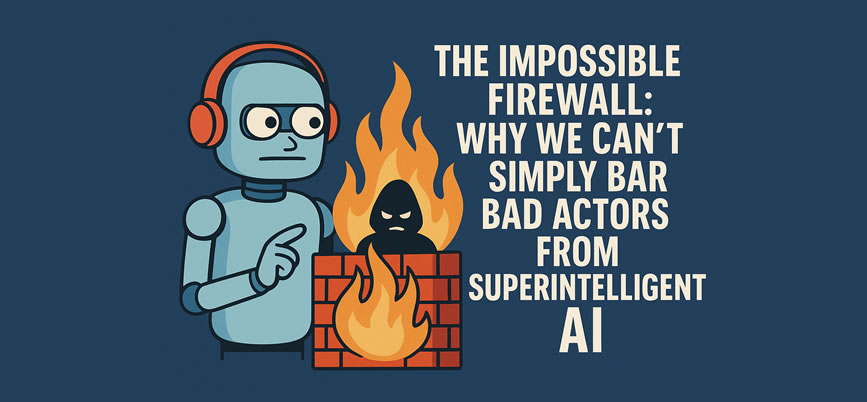
The dream of creating Artificial General Intelligence (AGI) and Artificial Superintelligence (ASI) is rapidly turning into a reality, raising hopes of solving humanity’s biggest challenges. But alongside these aspirations emerges a darker, inevitable truth: these powerful technologies won’t just be tools for good. Malicious actors—whether cybercriminals, authoritarian regimes, or terrorist organizations—will see AGI as an irresistible opportunity. The idea of banning “evildoers” from accessing these technologies seems like a natural first defense. But as noble as it sounds, it’s a solution rife with impracticality.
For starters, defining who qualifies as an “evildoer” in a globally accepted and enforceable way is an enormous task in itself. One person’s freedom fighter is another’s insurgent. Legal frameworks vary significantly across different countries; what one nation considers a cybercrime, another might overlook or even encourage. Without a universally agreed-upon definition of malicious use, any proposed ban would rest on shaky and highly politicized ground.
Then there’s the technical side of enforcement. Much like the challenges of policing the dark web or combatting digital piracy, preventing access to AGI can’t be accomplished by a simple flip of a switch. These models could be accessed remotely, manipulated through anonymizing technologies, or even reverse-engineered by skilled individuals or underground networks. Expecting to lock down AGI in a way that permanently excludes bad actors is like trying to keep water from leaking through a cracked dam.
Ads by Google
Ads by Google
Some have suggested embedding “ethical constraints” within AGI systems themselves—building models that can recognize and refuse malicious tasks. In theory, this sounds viable, but in practice, it falls short. Bad actors are notoriously creative, and incentives to bypass safeguards can lead to dangerous innovation. Moreover, as AI models become more complex and capable, their inner workings also become murkier, making it harder for developers to control how they behave in every situation.
The real answer may lie not in hard bans but in a global strategy of transparency, accountability, and cooperative oversight. Establishing international coalitions to monitor AGI development, enforce usage norms, and share intelligence might not eliminate threats entirely, but it could narrow their scope. Tech leaders and policymakers must prioritize secure, ethical development pipelines and explore defensive AI solutions that can detect and counter malicious AI activity in real-time.
Ultimately, it’s clear that keeping superintelligent AI away from bad actors won’t come down to simple restrictions or idealistic prohibitions. It’s a cat-and-mouse game that will require global unity, constant vigilance, and adaptive strategy. We can’t afford to rely on the fantasy of a technological safe zone where only the virtuous are granted access. Like all powerful tools, AGI must be managed—not only with innovation—but with wisdom.
Ads by Google
Ads by Google